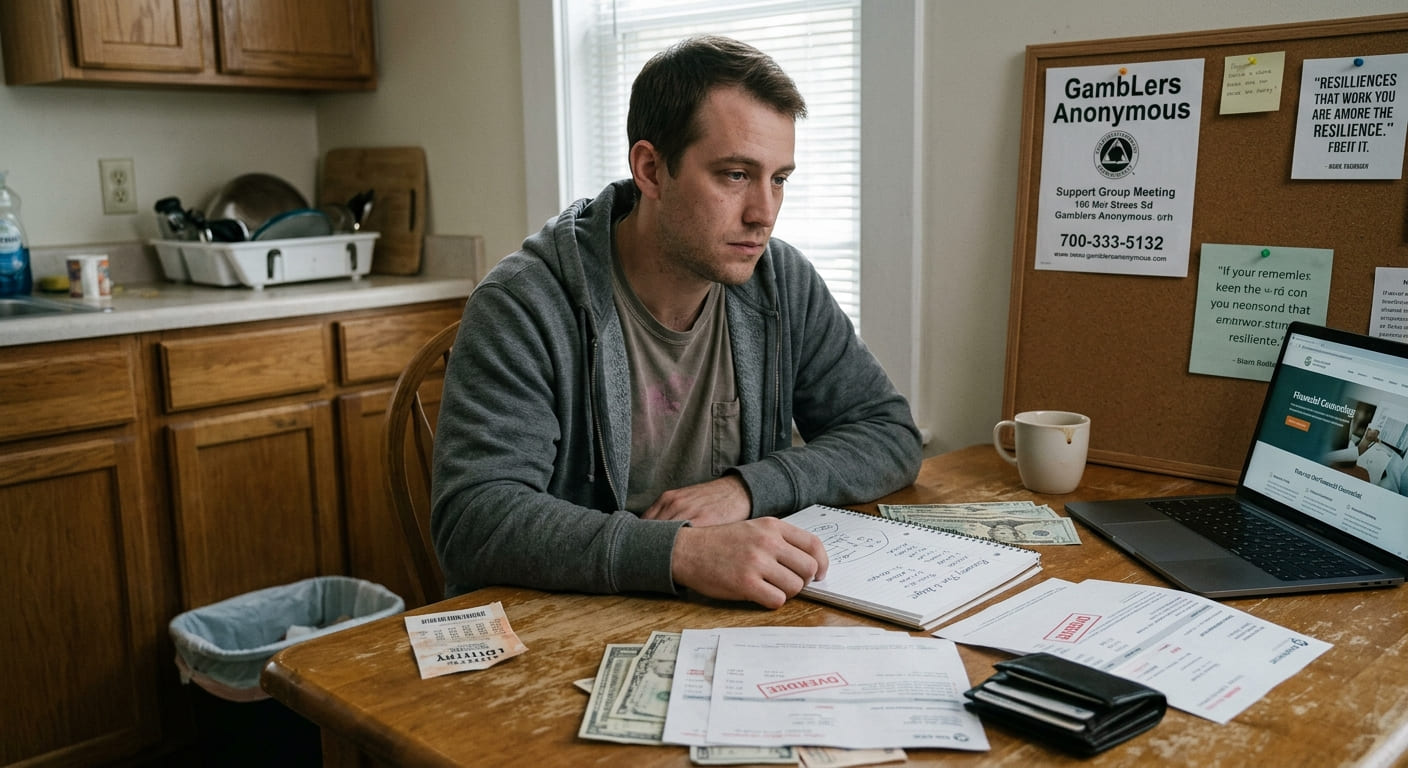
Maybe It Started With “Just One Bet”
It often starts with a simple thought:
“Maybe this one will work.”
Then comes another attempt.
Then another.
Sometimes you win.
Sometimes you lose.
But when the losses begin adding up, something changes.
You start thinking about getting the money back.
You tell yourself that one more attempt could fix everything.
You hide what you have lost.
You avoid telling people close to you.
You borrow money.
You promise yourself you are finished.
Then the urge returns.
If this is happening to you, you are not the only person who has found themselves caught in this cycle.
And you do not need to be free of debt, shame or fear before you can ask for help.
Wegotyoualways starts from where you are.
Gambling Problems Are About More Than Losing Money
Money is often the most visible consequence.
But gambling-related harm can spread into almost every part of someone's life.
The World Health Organization identifies gambling-related harms including:
- Financial distress
- Relationship problems
- Mental-health problems
- Poverty
- Neglect of responsibilities
- Family harm
- Other serious social consequences
That is why gambling problems should not simply be reduced to:
“You just need better self-control.”
For someone caught in a harmful pattern, it can be much more complicated than that.
What Is Gambling Disorder?
Gambling disorder is recognized by the World Health Organization in ICD-11 under disorders due to addictive behaviors.
The classification includes both predominantly online and predominantly offline gambling disorder.
The important issue is not simply whether someone has ever gambled.
It is whether gambling has become a persistent pattern that is difficult to control and is causing significant harm or impairment.
Millions of people may gamble without developing a disorder.
But for those who develop serious gambling problems, the consequences can be substantial.
The Trap of Trying to Win Your Losses Back
You lose money.
Then your mind says:
“I just need to win it back.”
It sounds logical in the moment.
But it can keep the cycle going.
Another loss creates another reason to try again.
Then the amount at risk can become larger because you are no longer gambling simply for entertainment.
You are trying to repair the damage caused by previous gambling.
This is commonly called chasing losses.
The important thing to remember is:
Previous losses do not create a debt that gambling can reliably repay.
Continuing to gamble can simply create more opportunities for additional losses.
The Warning Signs Can Appear Before Everything Collapses
You may want to take your gambling seriously if you:
- Think about gambling frequently.
- Feel restless or frustrated when you try to stop.
- Spend more money than you intended.
- Keep gambling after losing because you want to recover the money.
- Hide gambling activity from family or friends.
- Borrow money because of gambling.
- Use money meant for important expenses.
- Miss responsibilities because of gambling.
- Experience repeated arguments about money or gambling.
- Feel guilty or ashamed but continue.
- Make promises to stop and repeatedly return to gambling.
- Feel that gambling is becoming difficult to control.
You do not have to wait until you have lost everything before seeking help.
Gambling Can Become an Emotional Escape
Just like other addictive behaviors, gambling can become connected to emotions.
For some people, it is excitement.
For others, distraction.
For someone else, it may temporarily provide relief from:
- Boredom
- Loneliness
- Stress
- Financial frustration
- Emotional pain
That is why simply saying:
“I will never gamble again.”
may not address the whole problem.
You also need to understand:
“What was gambling doing for me emotionally?”
The answer can reveal an important part of your recovery plan.
Financial Problems Create Another Layer of Stress
This is where gambling can become especially difficult.
You lose money.
↓
The loss creates stress.
↓
The stress makes you want an escape.
↓
Gambling promises the possibility of fixing the financial problem.
↓
Another loss creates even more stress.
↓
The cycle continues.
Breaking that cycle requires separating recovery from the idea of winning money back.
Your recovery should not depend on the next result.
Start Protecting Your Finances
If gambling is causing financial harm, practical financial boundaries can become part of recovery.
Depending on your circumstances, this might include:
- Involving a trusted person in financial decisions.
- Separating essential household money from discretionary spending.
- Reviewing debts and obligations honestly.
- Seeking professional financial or debt advice.
- Creating barriers between yourself and gambling opportunities.
The goal is not punishment.
The goal is protection while you rebuild control.
Tell Someone You Trust
Secrecy gives addictive behavior room to grow.
You do not necessarily need to tell everyone.
Start with one safe person.
You could simply say:
“I have a gambling problem, and I am struggling to stop. I need some support.”
That sentence can feel incredibly difficult to say.
But you do not need a perfect explanation.
You just need to begin the conversation.
Change Your Environment
Recovery becomes harder when the same environment keeps triggering the same behavior.
If certain situations, devices, conversations or routines are strongly connected to gambling, creating distance from those triggers can help.
The goal is to make the automatic path less automatic.
When an urge appears:
- Give yourself time before acting.
- Leave the situation.
- Talk to someone.
- Do something that occupies your attention.
- Write down what you are feeling.
- Remind yourself what happened the last time you followed the urge.
The objective is to interrupt the cycle.
An Urge Is Not an Instruction
An urge can feel extremely powerful.
But an urge is not a command.
It rises.
It changes.
Eventually, it passes.
Learning to experience an urge without immediately acting on it is an important recovery skill.
You do not have to win an argument with your mind.
You simply need to create enough space to choose your next action.
Recovery Also Means Dealing with What Happened
If gambling has created debt, broken trust or damaged relationships, those problems will not disappear simply because gambling stops.
They may need their own recovery plan.
That could mean:
- Being honest about financial problems.
- Creating a realistic repayment plan.
- Rebuilding trust gradually.
- Apologizing without making promises you cannot keep.
- Getting professional financial advice.
- Seeking counselling or addiction support.
- Learning healthier ways to deal with stress and difficult emotions.
You cannot change yesterday.
But you can begin changing what happens next.
You Are Not Your Losses
This may be one of the hardest things to remember.
If you have lost money, you may feel stupid.
If you have lied to someone, you may feel ashamed.
If you have borrowed money, you may feel like you have disappointed everyone.
Those feelings are real.
But they do not have to become your identity.
You made decisions that had consequences. That does not mean you are incapable of making different decisions from here.
Recovery is about taking responsibility without turning responsibility into self-hatred.
Get Help Before the Problem Becomes Bigger
The World Health Organization identifies gambling disorder as a recognized health condition and notes that gambling-related harm can affect people beyond the person who gambles.
This is not simply about being “bad with money.”
It can become a serious health and wellbeing issue.
If gambling is affecting your:
- Finances
- Relationships
- Responsibilities
- Work
- Studies
- Emotional wellbeing
- Ability to control your behavior
consider speaking with a qualified mental-health or addiction professional.
If you are in immediate financial crisis or feel unsafe, seek urgent support from a trusted person or appropriate local emergency or health services.
Your First Step with Wegotyoualways
Maybe you have already tried to stop.
Maybe you have deleted accounts, made promises, hidden your losses or decided that tomorrow would be different.
And maybe tomorrow came and the cycle continued.
That does not mean there is no hope.
It means you may need more than willpower.
You need understanding.
You need practical tools.
You may need support from people who understand addiction.
And you need a recovery plan that deals with both the behavior and the life around it.
At Wegotyoualways, that is where we want to meet you.
Not after everything has been fixed.
Right here.
Start by:
- Being honest about what gambling has cost you.
- Understanding what triggers the behavior.
- Protecting what needs protecting.
- Bringing someone you trust into the process.
- Getting professional help where you need it.
- Taking the next decision without trying to solve your entire future today.
You do not have to win your way out of a gambling problem.
You can recover by stepping away from the cycle and rebuilding your life one decision at a time.
Wegotyoualways Is Here
You do not have to face the next step alone.
Start where you are.
Take the next step.
Wegotyoualways is here for the journey.
0 Comments
Login or sign up to leave a comment
No comments yet. Be the first to share your thoughts.